
Read Time 9 mins

"We'll look at it once we have reps." "Let's revisit after the ERP goes live." "Honestly? We're not there yet."
If you run a new furniture or lighting brand, you've probably said one of these. It sounds responsible. Why pay for sales software before the first purchase order clears?
Here's the catch. The "ready" moment you're waiting for rarely shows up on schedule. You sign reps before the catalog makes sense. You book a market booth before pricing is final. The ERP decision slides a quarter, then another. And the whole time, you're already selling: out of PDFs, a shared spreadsheet, and your own phone.
So set aside "are we ready?" A more useful question is which pieces of a sales enablement platform you need right now, and which can honestly wait.
Why Do Young Brands Say "It's Too Early"?
Ask a founder what "ready" means and you'll usually hear a list of missing things. An ERP. A product information management (PIM) system. A signed team of independent reps. Final price tiers. A catalog that finally stops changing. Until all of that exists, the thinking goes, software has nothing to connect to.
You'll recognize the people behind that answer:
- A made-to-order maker with a handful of prototypes, no price tiers yet, and a plan to call rep groups "soon."
- Entering a new country for the first time, a manufacturer decides to hold off on tools until it hires a sales team.
- Then there's the freshly formed joint venture, where every purchase waits for investors or partners to sign off.
Each call makes sense on its own. Line them up, though, and the same assumption appears: sales infrastructure is one big, all-or-nothing project that belongs at the very end of the build-out.
Why does that feel true? Partly because many founders picture sales software through the lens of an ERP rollout. Months of consultants, integration meetings, a go-live date everyone dreads. If sales enablement worked like that, waiting would be smart.
Young companies also build department by department. Finance first, operations next, sales tools "eventually." Sales doesn't wait its turn. The first rep meeting, the first designer email asking for dimensions, the first market booth: they all land on the calendar whether your systems exist or not.
And waiting looks free. A subscription shows up on the budget. The hours your team spends re-sending files and rebuilding quotes by hand never do.
What Does Waiting Actually Cost?
Picture this. You discontinue one finish. Now someone has to fix the spec sheet, the price list, the PDF catalog, last season's sell sheet, and every copy already sitting in your reps' inboxes. Then they have to hope nobody quotes the old version next week, because no one can check. That's data debt. It grows with every product, option, and rep you add, and you'll never have an easier time structuring product information than while your catalog is small.
Rep attention goes next. Independent reps carry several lines, and they spend their hours on whichever ones are easiest to show and quote. Your brand already walks in without a track record. Show up with a folder of attachments too, and you're asking a rep to do extra work for a line their dealers have never heard of. Most won't refuse out loud. They'll simply open someone else's catalog first.
The third cost creeps up slowly. The workarounds your team invents in year one become "how we do things" by year three. When a tool finally arrives, it often lands as a full rollout: every feature, every habit, all at once. For a team of five, that's a scope problem wearing a readiness costume.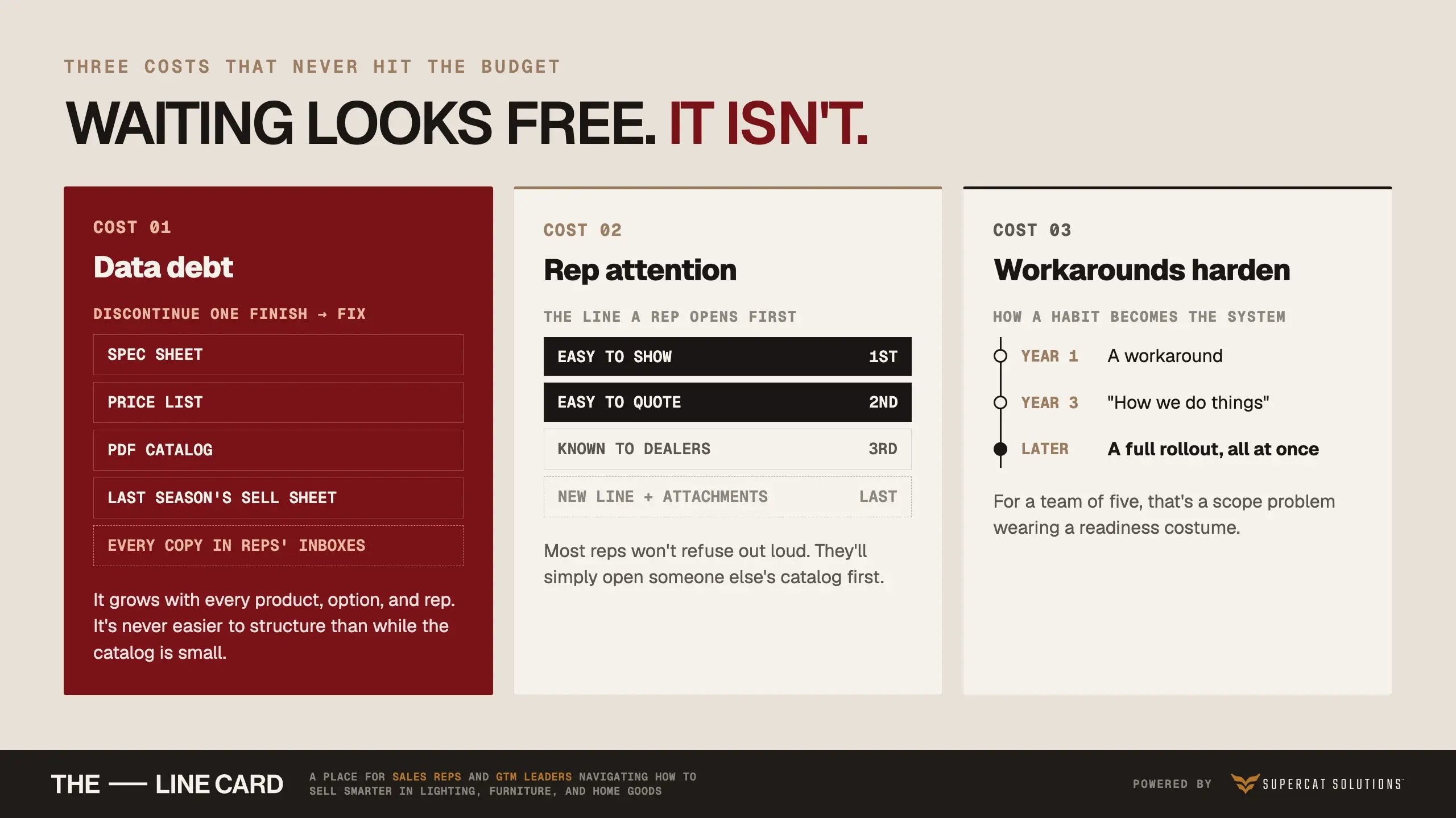
When Is "Too Early" the Right Answer?
Sometimes you really should wait. A checklist that always says "buy now" isn't worth your time, so here's when waiting makes sense:
- You're still the only people presenting the product. People adopt tools they need to get their work done, and at this stage those people haven't joined yet. A tool without them mostly sits unopened.
- Your product list changes every week. Structuring data you'll rewrite next month burns hours you don't have.
- Everyone on the team is already stretched, and nobody can own product data. A catalog without an owner goes stale fast.
- The layer you're eyeing depends on something that doesn't exist. ERP integration needs an ERP. Pricing rules need prices. Dashboards need order history.
Defer those. Just don't let them become the excuse to defer everything else.
Who Feels the Cost of Waiting?
Your sales tools, or the lack of them, hit the people you most need to win over first.
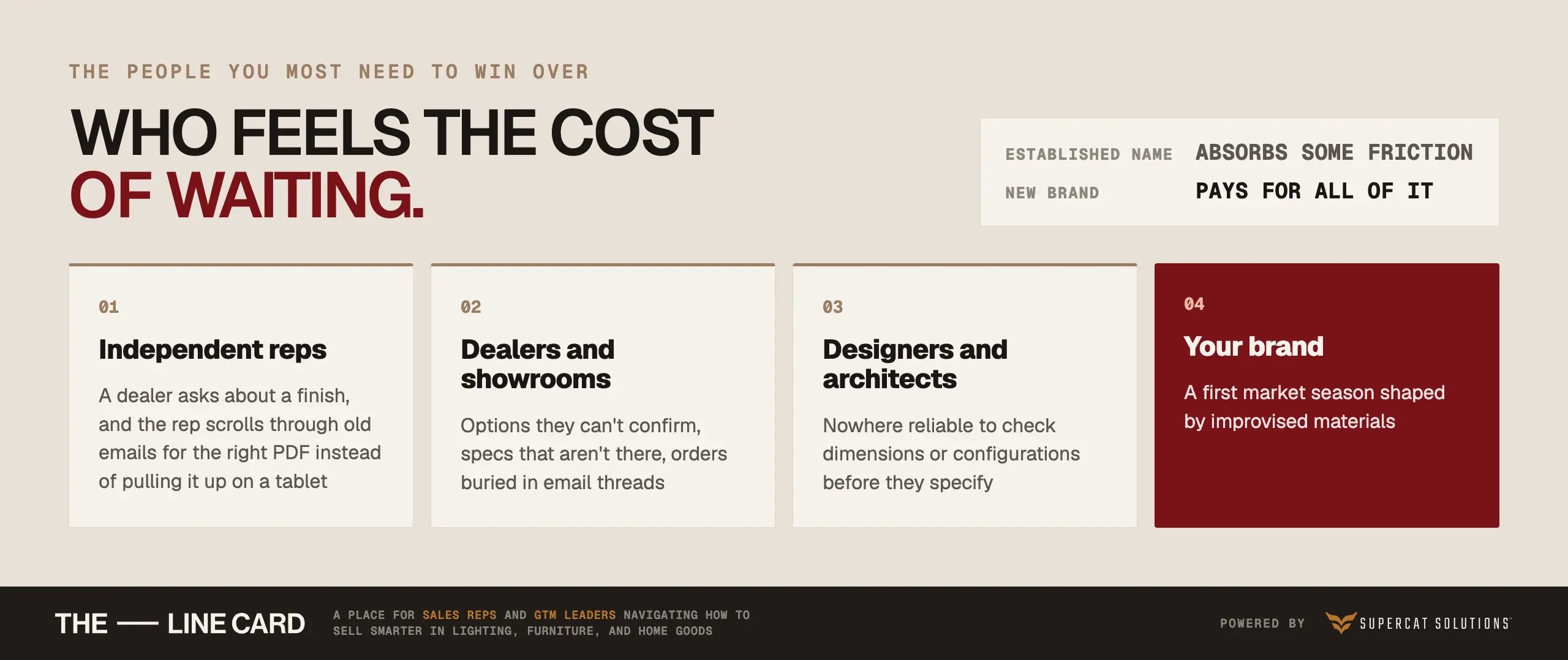
In your first seasons, buyers judge you partly on how easy you are to work with. An established name can get away with some friction. A new one pays for every bit of it.
How Can Sales Enablement Be Adopted in Layers?
The "too early" logic held up back when sales software meant one massive implementation. Most modern B2B commerce tools work in layers instead. Product data sits at the bottom. Presentation goes on top of it. Quoting and ordering come next, with integrations and analytics last. You start at the bottom and add a layer once your business gives it something to work with.
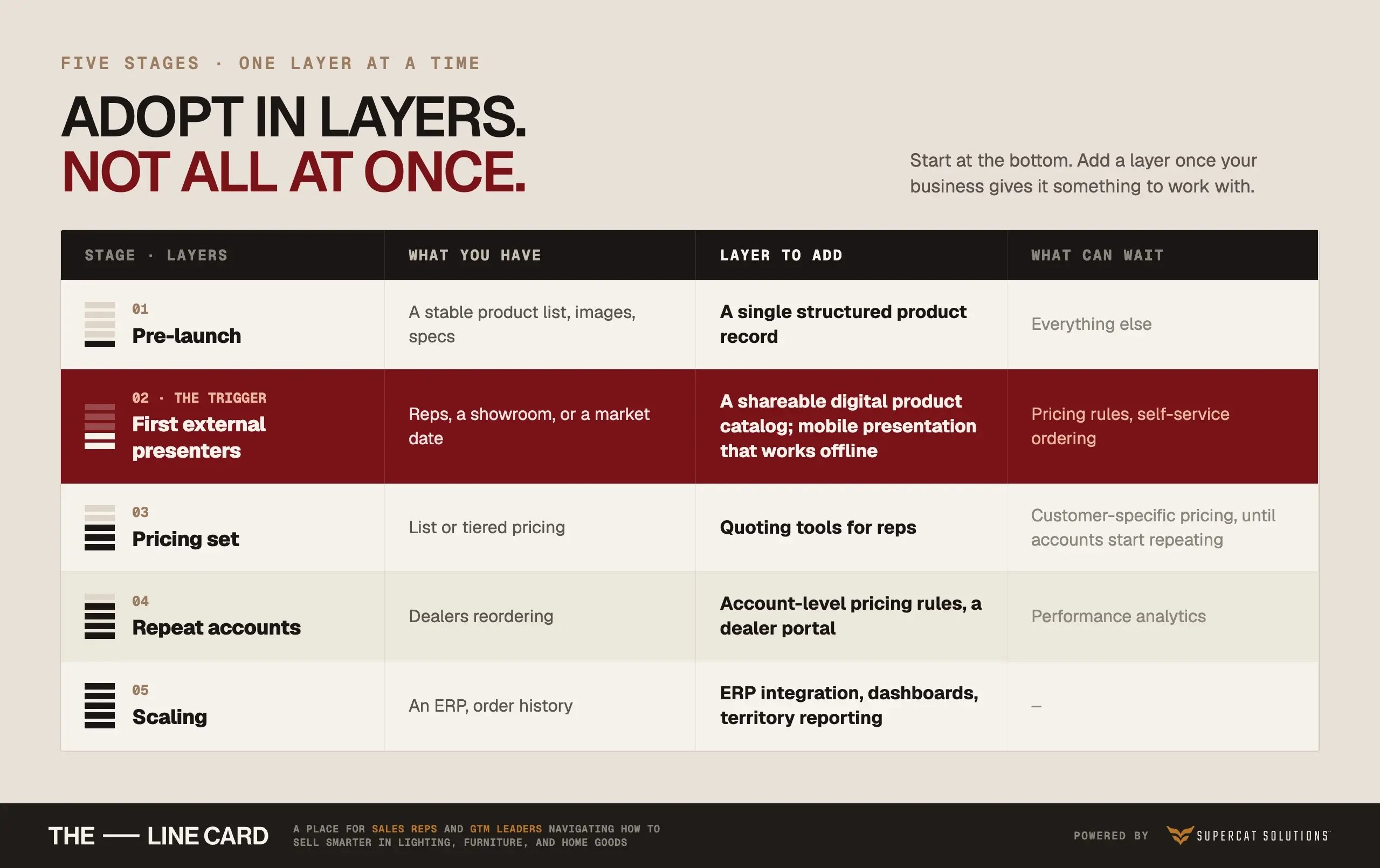
If you sell made-to-order, layering solves a familiar headache. You can structure options, finishes, fabric grades, and dimensions before you set a single price, because configuration is product knowledge. Pricing is its own layer. Add it once your tiers settle.
What Does the First Layer Require From Your Team?
Here's what "too early" often really means. A small team rarely lacks interest. It lacks hours, budget, and someone to own the work.
The first layer asks for four things:
- One person who owns product data. Part-time works.
- A first cleanup, so names, attributes, options, and images all live in one place and follow the same pattern.
- An agreed routine for adding, changing, and retiring products, plus a clear answer to "who does it?"
- A short walkthrough for your first users. Reps should know where the catalog lives and trust that it's current.
You don't need an ERP, an integration project, or final pricing.
Budget frozen? You can still do most of the groundwork without buying anything. Build one master file the way a sales platform would want it: a row per product, the same attributes for every item, options spelled out instead of buried in notes. That single file clears most of your data debt and speeds up whatever you implement later. You can pause the purchase without pausing the structure.
What Should You Adopt Now, and What Should You Defer?
Go through these honestly. Watch the right-hand column closely: it keeps "later" from quietly turning into "never."
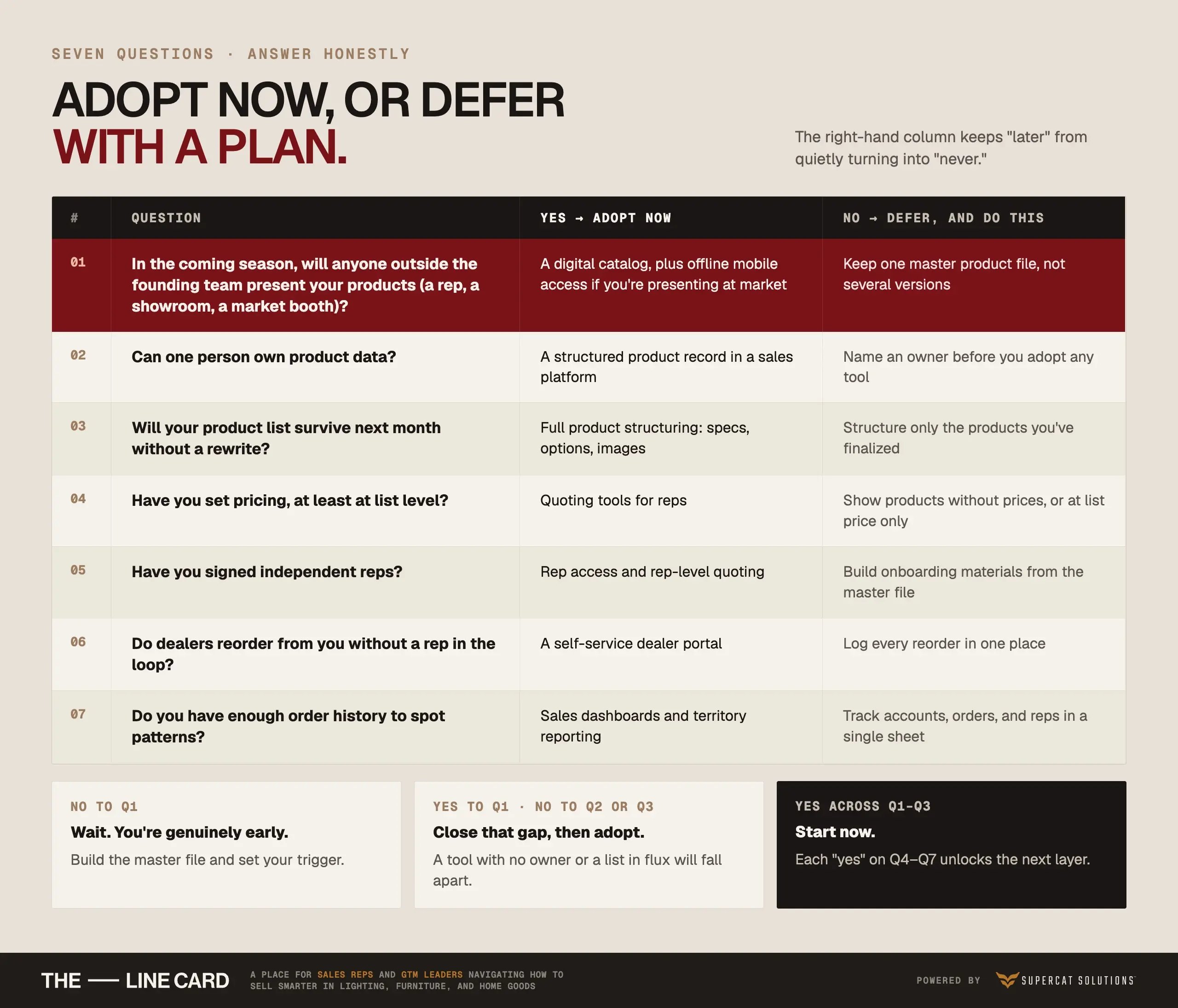
Reading your answers:
- Answered "no" to question 1? Wait. You're genuinely early. Build the master file and set your trigger: the first person outside the team who'll present your products.
- "Yes" to question 1, but "no" to 2 or 3? You need the first layer, but a tool with no owner or a product list in flux will fall apart. Close that gap, then adopt.
- "Yes" across 1–3? Start now. From there, each "yes" on questions 4–7 unlocks the next layer. Each "no" waits for its own trigger.
Two habits keep this checklist honest. First, tie decisions to triggers, not dates. "We'll revisit when the first rep signs" follows your real needs; "we'll revisit in Q3" just follows the calendar. Second, before you adopt anything early, make sure the platform can start with a simple product file and grow into pricing, ordering, and ERP integration later. Starting small shouldn't force you to switch platforms in two years.
How Early Is Too Early?
Usually, "too early" describes scope, not the calendar. No young brand needs a fully connected sales stack before its first order. And some brands really are early: nobody outside the team is selling yet, the product list keeps moving, and no one has room to own the data.
But the day someone outside your founding team starts presenting your products, clean product data and a decent way to show it stop being nice-to-haves. That day tends to arrive well before the ERP, the full rep network, or the final price list.
Want a quick gut check? Pick one product and count how many files hold its price. If you count more than one, you're already paying for the wait.