
Read Time 8 mins
Every June and January, Dallas Market Center hosts Lightovation, the largest residential lighting trade show in North America, spanning roughly one million square feet of exhibits. Lightovation 2026's summer edition ran June 24–27, immediately following Design + Build Day on June 23, and overlapped with the broader Total Home & Gift Market, which continued through June 30.
On paper, that's a familiar rhythm for the industry. What made this particular edition worth analyzing was the operational pressure surrounding it, and a quiet but telling shift in how the show chose to recognize excellence.
Trade Shows Are Outrunning Sales Enablement Platforms
Lighting and furniture sales organizations still treat market weeks like Lightovation as the centerpiece of their annual sales calendar. Reps spend months preparing, manufacturers spend significant budget on showroom presentation, and an outsized share of new accounts, designer relationships, and dealer commitments still trace back to a few concentrated days on a market floor.
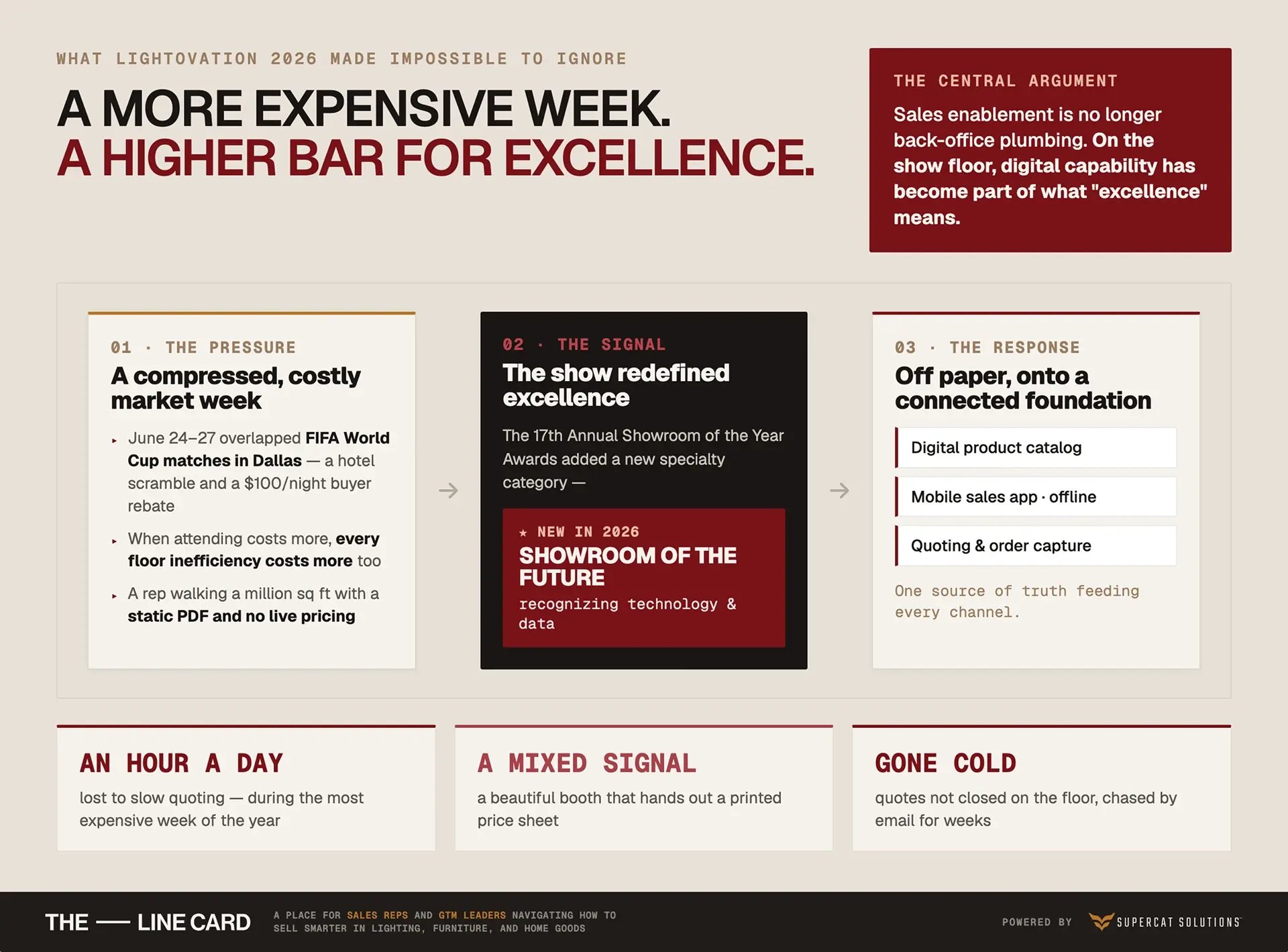
The problem is that the supporting infrastructure hasn't always kept pace with the events themselves. A rep walking a million square feet of exhibits with a static PDF catalog and no real-time pricing is operating with the same toolkit that existed a decade ago, even though buyer expectations, product complexity, and the logistics of attending have all changed considerably.
June 2026 made that gap harder to ignore.
Why Lightovation 2026's Calendar Turned Logistics Into a B2B Sales Automation Problem
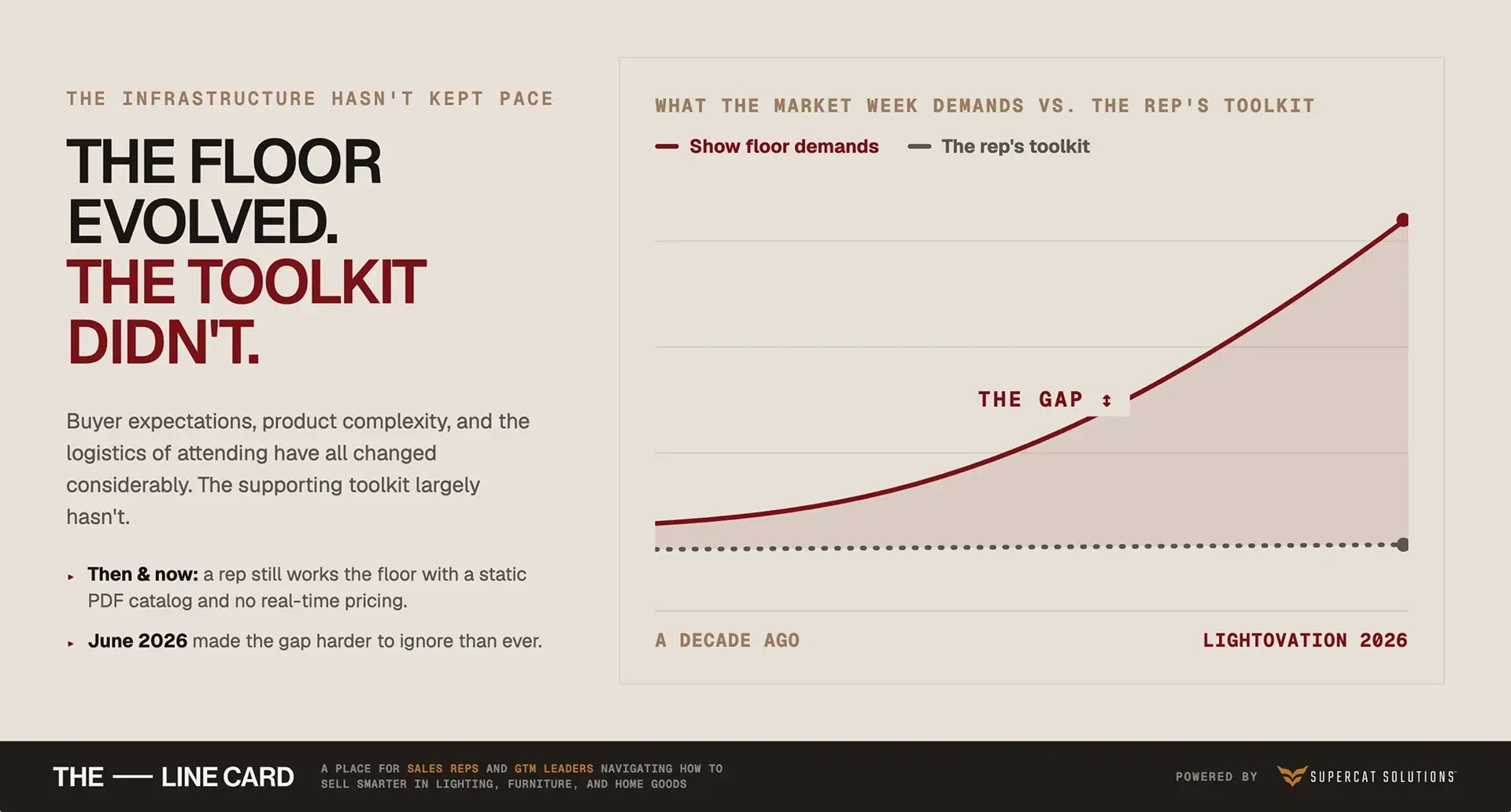
This year's summer show landed in the same week Dallas hosted FIFA World Cup 2026 matches, including a Group Stage match between Argentina and Jordan on June 27 — the final day of Lightovation itself. Dallas Market Center responded by securing thousands of hotel rooms in advance and offering a $100-per-night rebate to qualified buyers who booked early, explicitly flagging that availability would be tighter than usual.
That's a small detail with a larger implication. When travel, lodging, and even ground transportation around a market week become competitive resources, the cost of attending in person rises — and so does the cost of every inefficiency once a rep actually gets on the floor. A team that loses an hour a day to slow quoting or outdated product information is losing it during a week that was already more expensive and harder to plan than usual. Sales enablement platforms exist precisely to absorb that kind of friction, turning a compressed, high-pressure market week into something a rep can still execute well under pressure.
From Showroom of the Year to Showroom of the Future
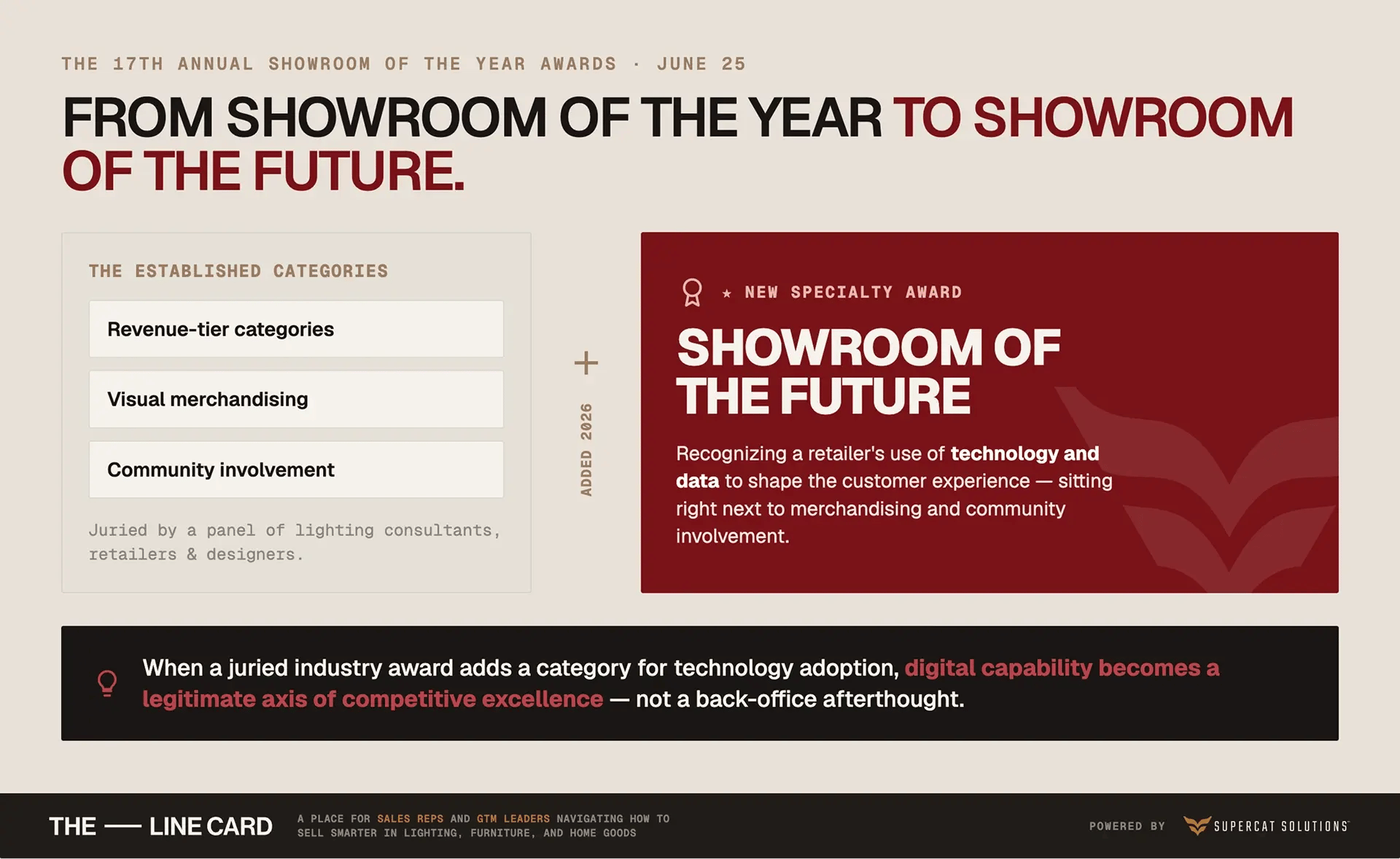
The clearest evidence of where the industry is heading came from the show's own awards program. Lightovation's 17th Annual Showroom of the Year Awards, presented in partnership with Lighting News Now editor-in-chief Linda Longo and judged by a panel including lighting consultant Kelly Inglis, Kenneth Ludwig of Kenneth Ludwig Chicago, and John Mark Sharpe of John Mark Enterprises, were held Thursday, June 25, at the Trade Mart 3 Loft Main Stage.
Alongside the traditional revenue-tier categories and merchandising and community-involvement honors, this year's program included Showroom of the Future — a specialty award designed specifically to recognize a retailer's use of technology and data to shape the customer experience. That a juried industry award now has a category for technology adoption, sitting next to categories for visual merchandising and community involvement, is a meaningful marker. It suggests the judging panel sees digital capability as a legitimate axis of competitive excellence, not a back-office afterthought.
The show floor reinforced the same theme in quieter ways. The Exteriorscape display, a dedicated showcase of outdoor and architectural lighting collections on the Trade Mart's third floor, carried over from January into the June show, giving exhibitors and buyers a second pass at evaluating exterior lighting trends. The International Pavilion continued to bring global manufacturers into the same conversation as domestic brands, while the Spectrum Shared Showroom added new entrants in decorative residential and commercial lighting. None of this is unusual for Lightovation. What's notable is how much of the show's curated programming — awards, displays, designer-focused days — is increasingly organized around helping buyers and retailers operate more intelligently, not just discover more product.
Choosing Furniture and Lighting Sales Software
For Manufacturers
The practical takeaway is that showroom presentation and digital sales infrastructure are being evaluated together, by judges, designers, and increasingly by buyers themselves. A beautifully merchandised booth that hands out a printed price sheet sends a mixed signal.
For Distributors and Showrooms
Particularly those representing multiple lighting and furniture lines through the concurrent Total Home & Gift Market, the complexity is compounding. Reps juggling SKUs across several brands need a single, reliable way to access specs and pricing rather than separate paper catalogs per manufacturer. This is exactly where furniture sales software and lighting-specific platforms increasingly overlap in function, even when the products themselves don't.
For Independent Sales Reps
A market week complicated by travel logistics is a week where mobile sales apps with offline access stop being a convenience and start being the difference between closing a quote on the floor or chasing it down weeks later by email.
For Designers and Trade Professionals
Who increasingly expect to browse, configure, and specify digitally before or after a show like this, the bar set by Showroom of the Future-style recognition raises their expectations of every brand they work with going forward.
The Technology Shift
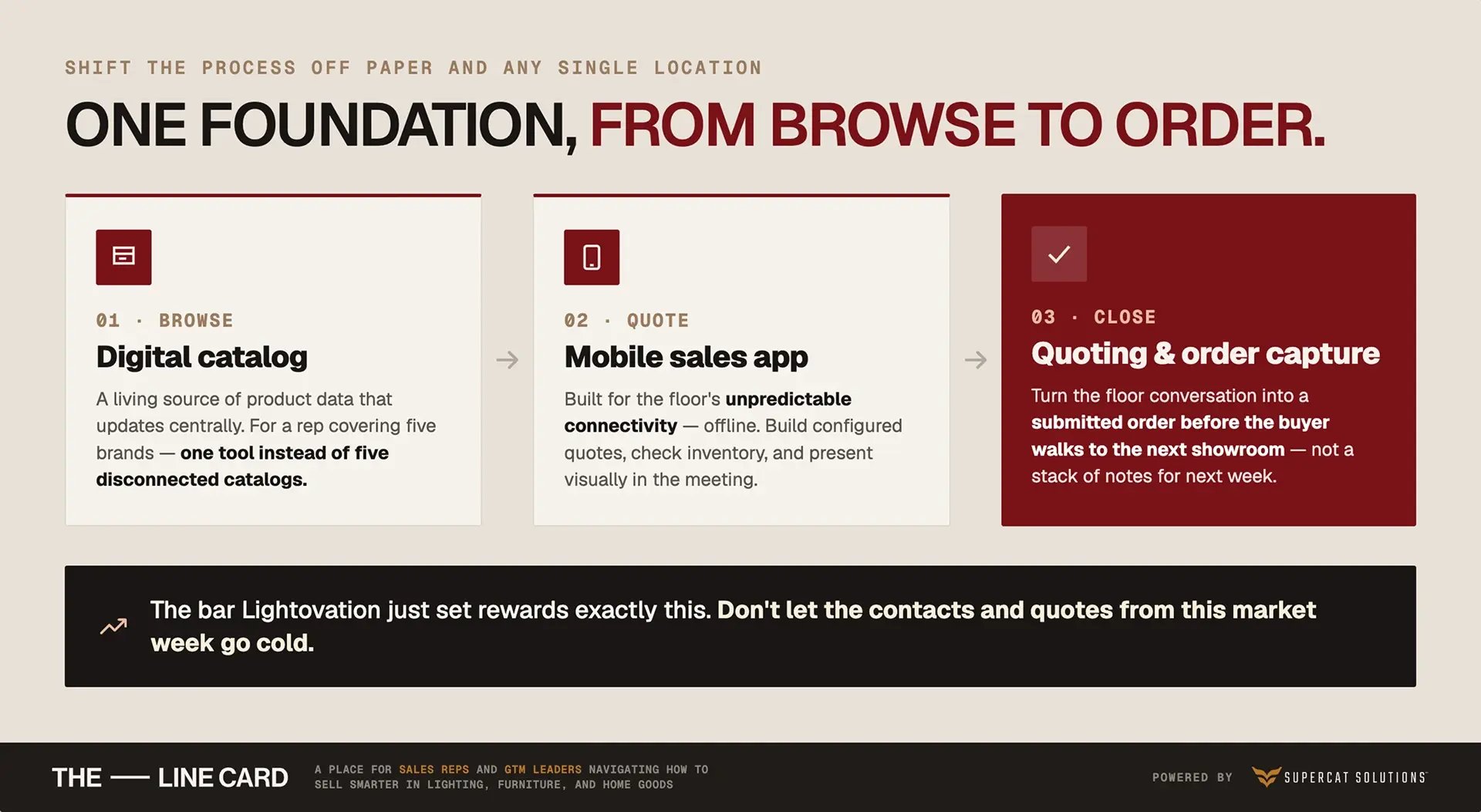
The structural answer to all of the above is the same one the industry has been moving toward for several years now: shift the sales process off paper and off any single physical location, and onto a connected digital foundation.
Digital product catalogs replace static PDFs or printed binders with a living source of product data that updates centrally and is instantly reflected everywhere. For a rep covering five brands at Lightovation, that means one tool instead of five disconnected catalogs.
Mobile sales apps extend that same data to the floor itself, with offline access built for exactly the kind of unpredictable connectivity a crowded trade show floor produces. Reps can build configured quotes, check real-time inventory, and present visually during a buyer meeting without waiting for a follow-up call.
Quoting tools for manufacturers close the loop by turning that floor conversation into a submitted order before the buyer walks to the next showroom, rather than a stack of notes to process the following week.
What to Evaluate in Lighting Sales Software and Product Information Management
Heading into the next Lightovation cycle, sales and operations leaders should be asking a narrower set of questions than "do we need new software":
- Does your product information management system serve as a single source of truth across ERP, CRM, and every rep's device, or are reps still reconciling versions manually?
- Can your team quote and configure offline, given that trade show connectivity is inconsistent at best?
- Is your digital catalog actually used in the field, or does it exist as a website nobody opens during a live buyer conversation?
- Does your B2B commerce tooling let dealers and designers self-serve between market weeks, so momentum from a show like Lightovation doesn't stall the moment the rep leaves the room?
- Would your current setup earn a "Showroom of the Future"-style nod, or would it look dated next to the retailers now being recognized for exactly that?
None of these questions require a complete platform overhaul to answer honestly. They do require an honest look at where manual workarounds have quietly become permanent.
Conclusion
Lightovation 2026's summer edition will likely be remembered for the World Cup-driven hotel scramble and a packed concurrent calendar more than for any single new product launch. But the more durable signal came from the show's own award stage: when an industry's most established recognition program adds a category for technological sophistication, it's telling the rest of the market where the bar is moving. Sales enablement platforms, digital catalogs, and B2B sales automation are becoming part of what "excellence" means on the show floor itself.